• Part: UCC28070-Q1
  • Description: PFC Controller
  • Manufacturer: Texas Instruments
  • Size: 911.92 KB
Download UCC28070-Q1 Datasheet PDF
Texas Instruments
UCC28070-Q1
UCC28070-Q1 is PFC Controller manufactured by Texas Instruments.
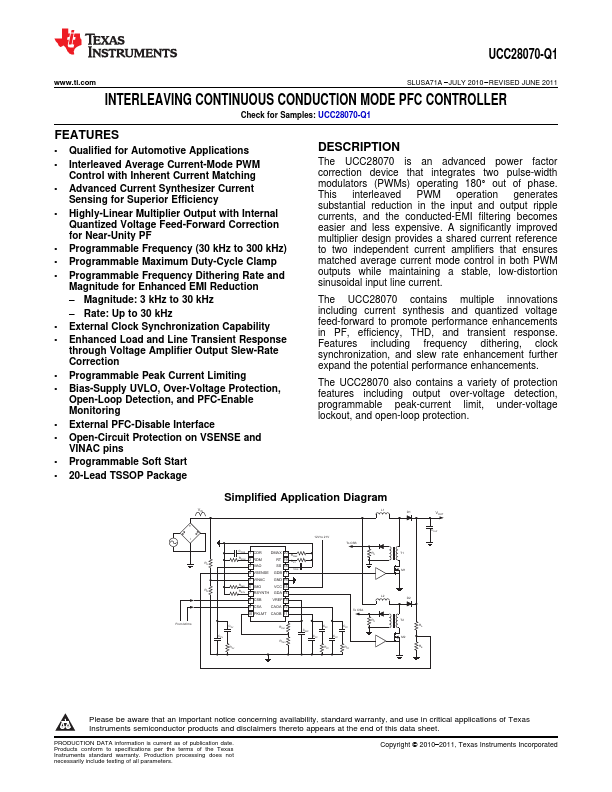
.ti. SLUSA71A - JULY 2010 - REVISED JUNE 2011 INTERLEAVING CONTINUOUS CONDUCTION MODE PFC CONTROLLER Check for Samples: UCC28070-Q1 Features - Qualified for Automotive Applications - Interleaved Average Current-Mode PWM Control with Inherent Current Matching - Advanced Current Synthesizer Current Sensing for Superior Efficiency - Highly-Linear Multiplier Output with Internal Quantized Voltage Feed-Forward Correction for Near-Unity PF - Programmable Frequency (30 k Hz to 300 k Hz) - Programmable Maximum Duty-Cycle Clamp - Programmable Frequency Dithering Rate and Magnitude for Enhanced EMI Reduction - Magnitude: 3 k Hz to 30 k Hz - Rate: Up to 30 k Hz - External Clock Synchronization Capability - Enhanced Load and Line Transient Response through Voltage Amplifier Output Slew-Rate Correction - Programmable Peak Current Limiting - Bias-Supply UVLO, Over-Voltage Protection, Open-Loop Detection, and PFC-Enable Monitoring - External PFC-Disable Interface - Open-Circuit Protection on VSENSE and VINAC pins - Programmable Soft Start - 20-Lead TSSOP Package DESCRIPTION The UCC28070 is an advanced power factor correction device that integrates two pulse-width modulators (PWMs) operating 180° out of phase. This interleaved PWM operation generates substantial reduction in the input and output ripple currents, and the conducted-EMI filtering bees easier and less expensive. A significantly improved multiplier design provides a shared current reference to two independent current amplifiers that ensures matched average current mode control in both PWM outputs while maintaining a stable, low-distortion sinusoidal input line current. The UCC28070 contains multiple innovations including current synthesis and quantized voltage feed-forward to promote performance enhancements in PF, efficiency, THD, and transient response. Features including frequency dithering, clock synchronization, and slew rate enhancement further expand the potential performance...